Manage access, monitoring, reports and automations with finer controls, including network restrictions, bulk custom fields and direct software removal. Build custom checks visually, improve remote support and monitor more storage and power systems.
New
Access and device management
Managed browser extensions — Deploy Chrome, Edge and Firefox extensions on Windows, macOS and Linux through an automation, including imports from a validated spreadsheet.
Access restricted by network — Limit invitation onboarding, interactive sessions, the web console and MCP clients to approved IPv4 or IPv6 addresses and networks.
Automatic monitoring for discovered devices — Assign compatible monitoring profiles automatically to supported network devices after discovery.
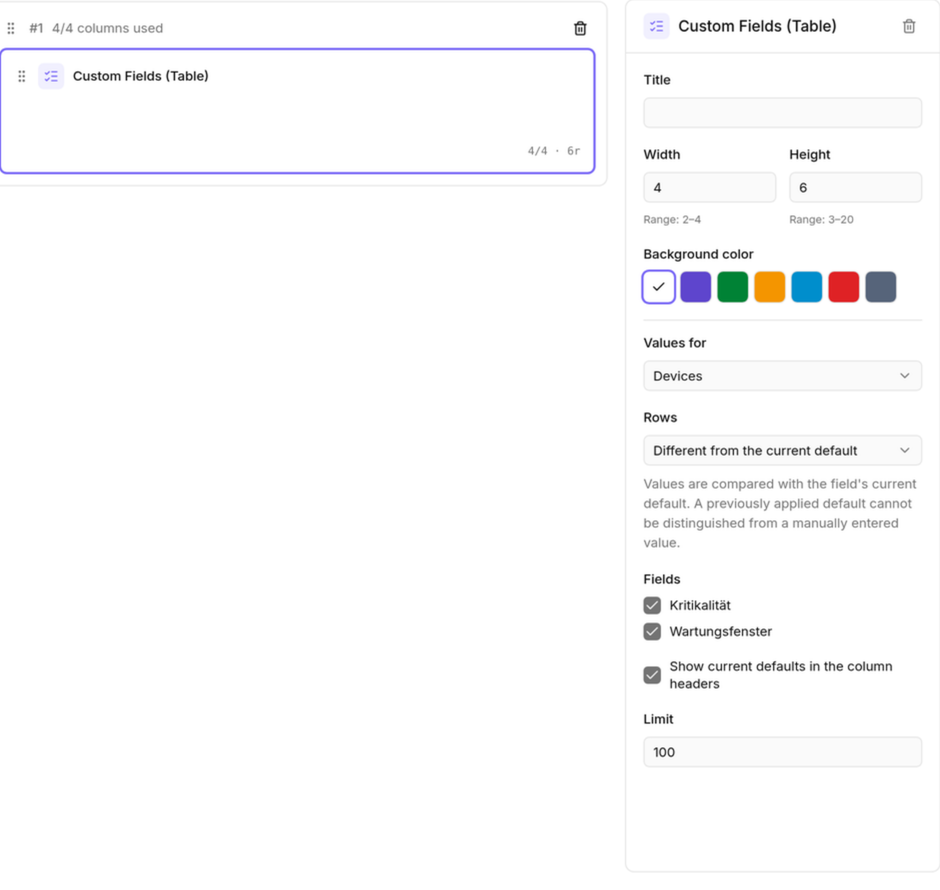
Bulk custom-field updates — Set one custom field on multiple selected devices in a single operation.
Uninstall software from device inventory — Remove inventoried Windows software directly from a device's Software tab without writing a script.
Matching patch policies from a device — Open the patch policies and rings that apply to a device directly from its device view.
Remote support
Reusable remote-support technician names — Define a technician-name template once for remote-support consent prompts while retaining optional names for individual users.
Reports and automation
Network devices report widget — Add a filtered table of network devices and their status details to reports.
Custom fields in report tables — Choose customer- or device-level data as columns and use those values to narrow results.
Combined PDF delivery for scheduled reports — Send every selected report in one ordered PDF.
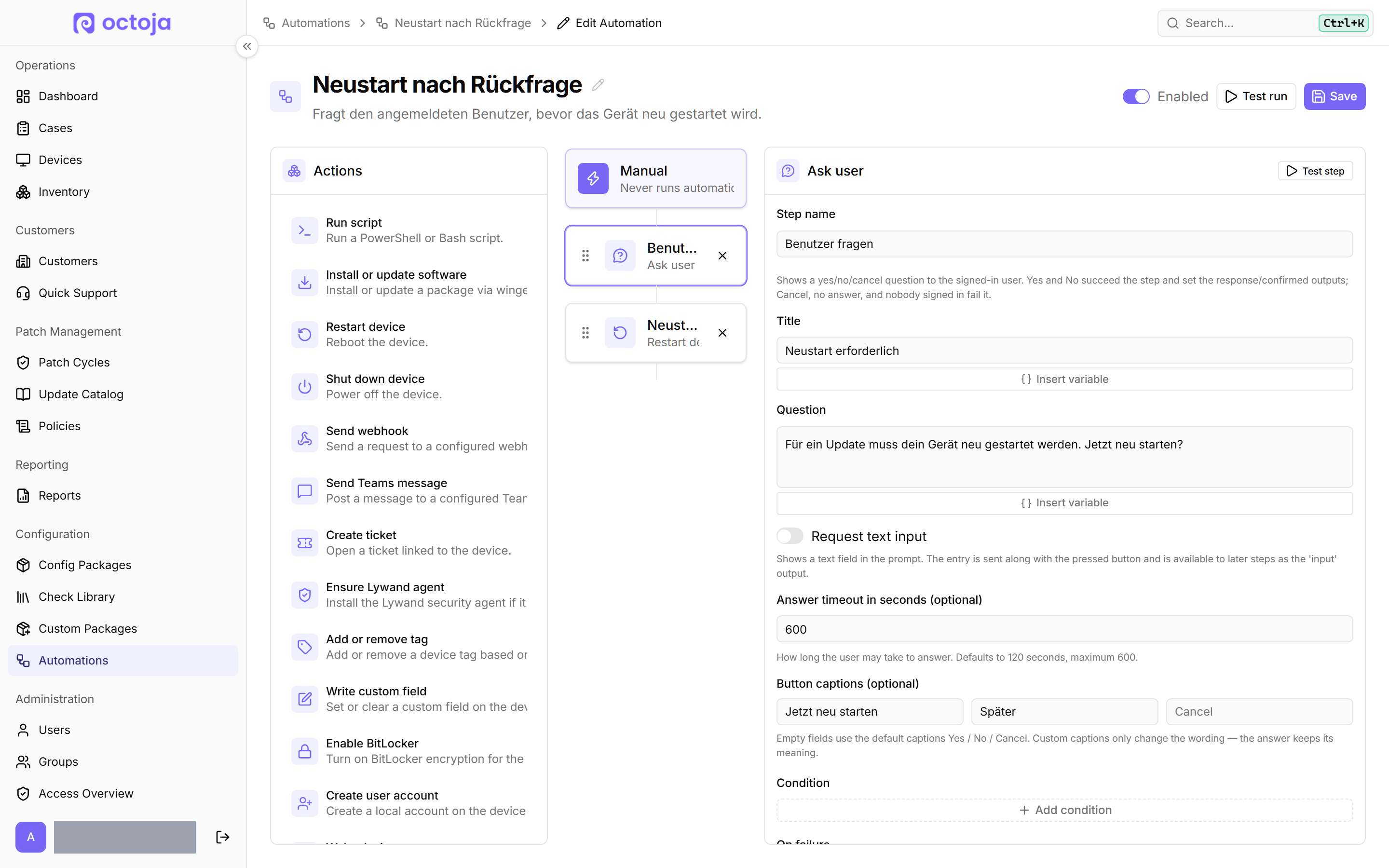
Structured prompts in automations — Request responses in a defined data format instead of relying only on free-form text.
Markdown custom fields — Store longer formatted content in custom fields and use it throughout octoja and in reports.
Integrations and alerts
c-entron Service Board request assignments — Choose a department and technician when creating c-entron Service Board requests from octoja.
UniFi Fabrics per customer — Optionally store a separate UniFi Site Manager API key for each customer and map its controllers to customer sites.
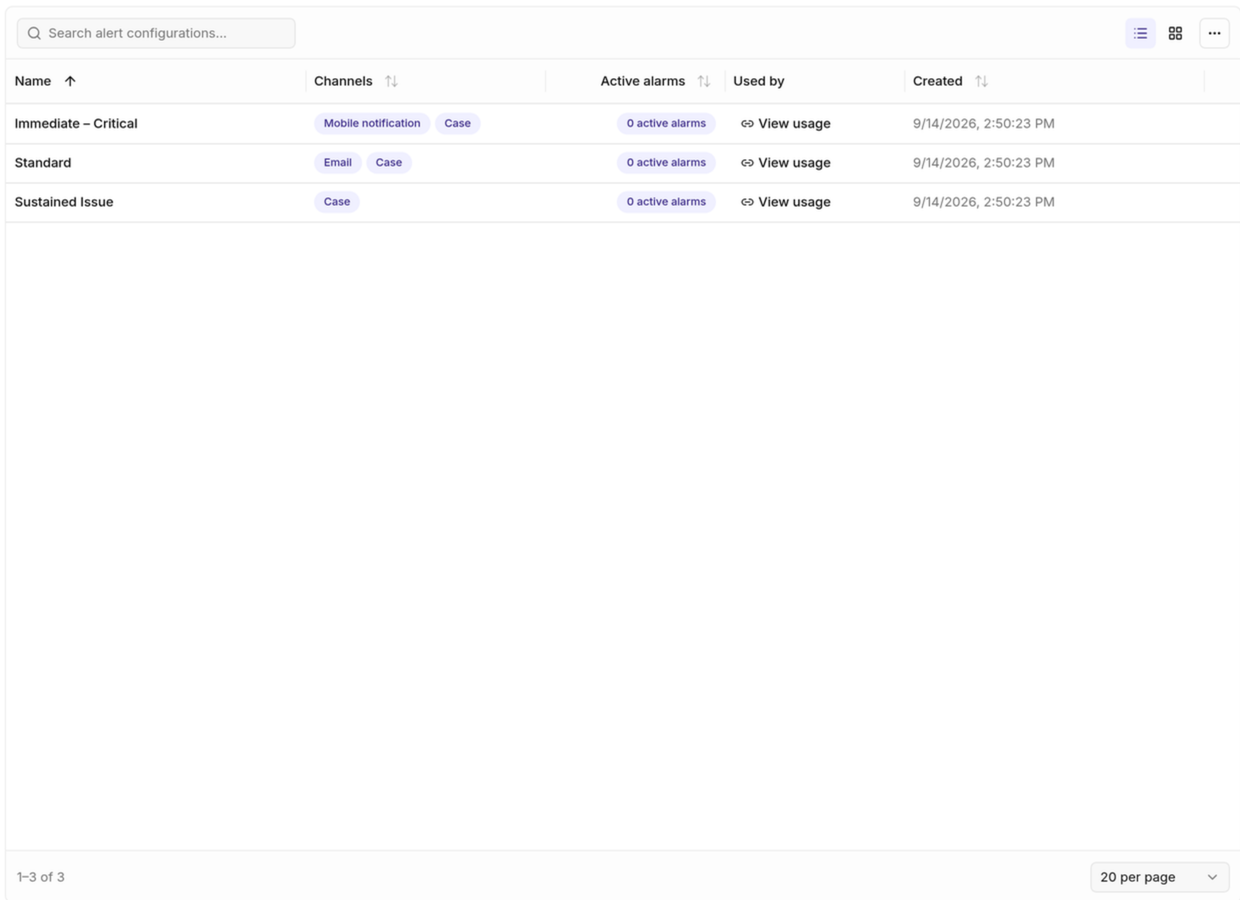
Alert configuration overview and recovery — Review configurations, their usage and all active alarms centrally, then send recovery notifications for selected alarms.
Custom-check authoring
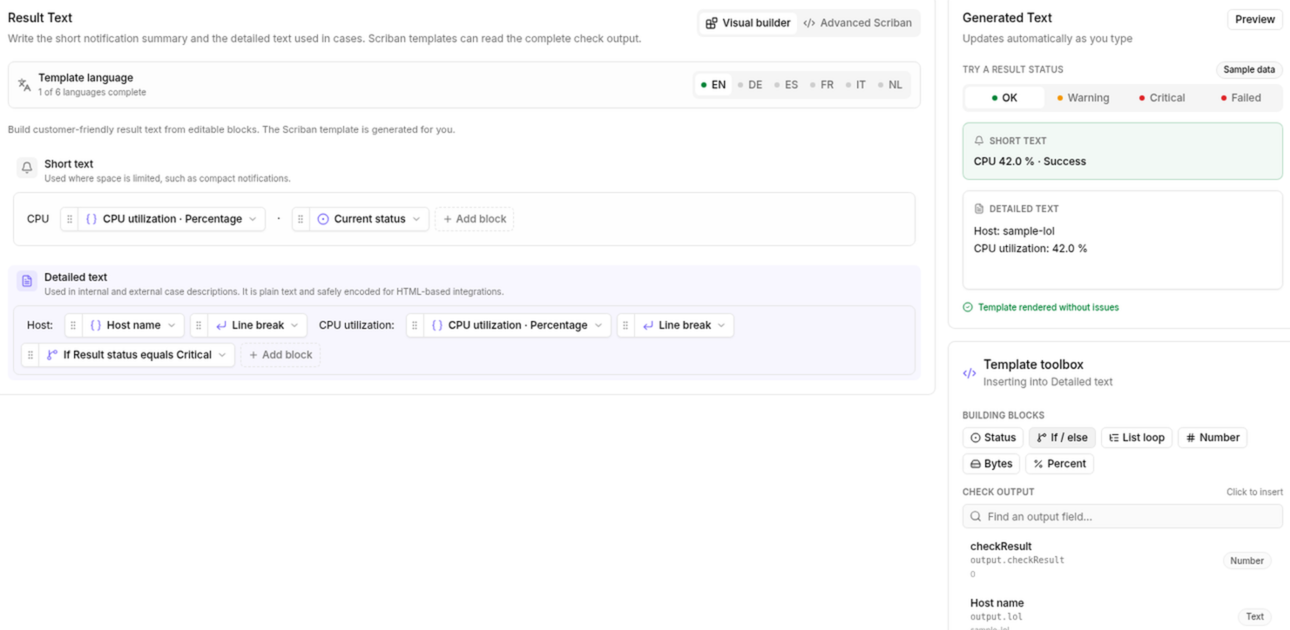
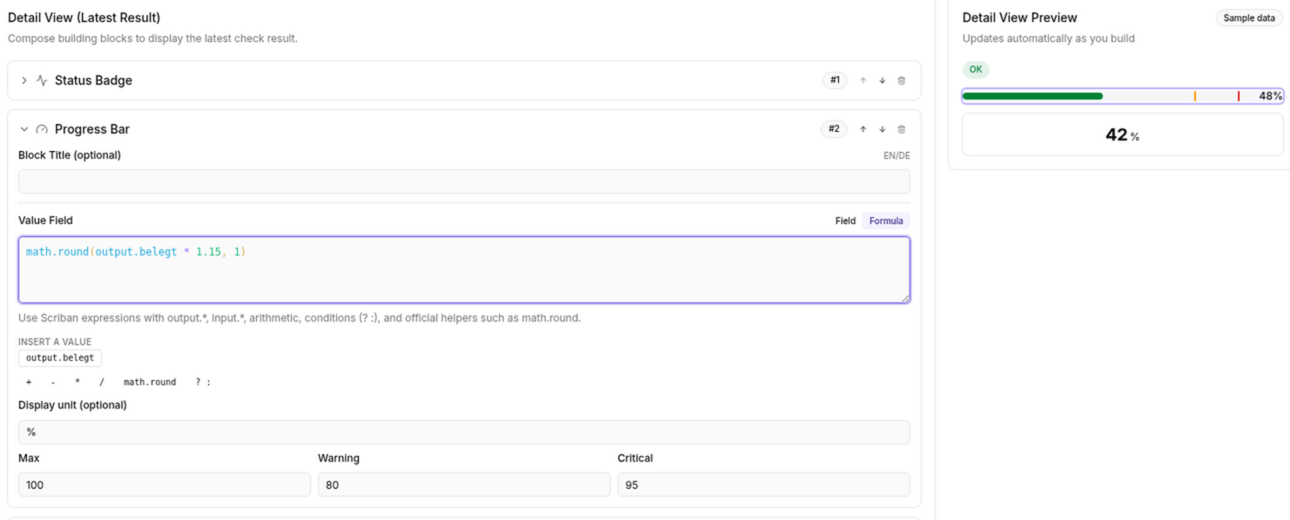
Visual custom-check result builder — Assemble result text from configurable blocks instead of editing a complete template by hand.
Formula studio for custom checks — Build formulas for result layouts and preview their output while you work.
Improved
Devices and configuration
Run assigned automations from a device — Start an automation already assigned to a device directly from that device.
Open devices from check overrides — Jump directly from an override to the affected device.
Clearer configuration package contents and schedules — Choose which modules a new package contains, see software deployment schedules and retain filters in the page URL.
Active Directory account status and filters — See and filter enabled, disabled, locked and expired accounts.
Patches and monitoring
More patch and automation controls for MCP clients — Authorized clients can read patch policies and cycles, and update or delete automations as well as create them.
Configurable Dell and Wortmann warranty alerts — Choose when expiring Dell and Wortmann warranties trigger warnings.
Ignore unregistered 3CX extensions — Exclude extensions that are intentionally unregistered from warnings.
Safer patch-policy maintenance and reuse — Control automatic maintenance per policy and copy an existing policy when creating another.
Automation and daily work
Move agent dialogs out of the way — Drag message, QuickSupport and macOS permission dialogs aside when they cover other work.
Formatted end-user notifications — Format automation notifications with Markdown and review sent messages in the device log.
Complete integration history — Search, filter and export the full history across supported providers.
Shared saved automations for scoped technicians — Let technicians run visible shared automations for the customers they are permitted to manage.
TV counters follow active filters — See counters that match the alarm filters currently selected on the TV view.
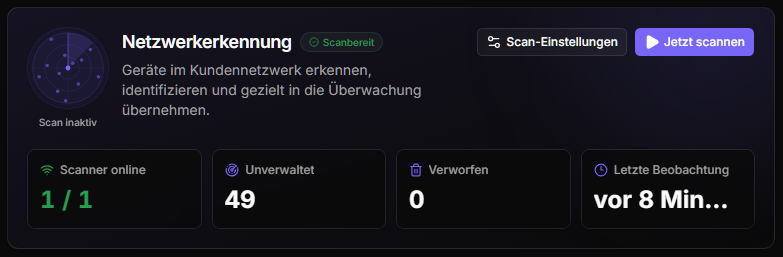
Dedicated navigation for network scans — Open network scans from a dedicated customer navigation entry, governed by its own permission.
Customer reference numbers in automations — Use a customer's reference number as an automation input.
Direct tag actions in automations — Choose Add tag or Remove tag directly instead of building a conditional workaround.
Reports, setup and security
Originating devices in delivery history — See which device produced each notification or alarm delivery.
Customer details in backup reports — Group results by customer and choose how customer identity appears.
Authenticator recovery with mandatory 2FA — Reset an authenticator enrollment without temporarily turning off mandatory two-factor authentication.
Automatic Windows prerequisites during agent setup — Install a missing supported .NET Framework automatically, with the deployment page explaining what setup provides.
Event-driven storage inventory — Refresh storage details when devices report changes instead of waiting only for the next scheduled collection.
Editors and remote access
Clearer custom-check layouts and result text — Insert result values into layouts and edit result text in a dedicated workspace.
Structured editor for nested rule conditions — Alternatives, AND conditions and multi-value inputs are grouped visually, making complex rules easier to scan and change.
Remote-support permissions during Mac onboarding — New Macs can grant remote-support permissions during setup, and users can reopen permission setup from the agent menu.
File Explorer limited to active remote sessions — Require an active remote-desktop session before a user can open a device's remote File Explorer.
Fit remote desktop to the remote screen — Resize the remote-desktop window to the remote screen's native size without changing its resolution.
Fixed
Software and notifications
Custom software versions resolve reliably — Custom software deployments now find the selected package version reliably.
Notifications recover after restarts — Pending notifications resume automatically after a service restart.
Monitoring continues through refresh failures — Agents keep their existing monitoring checks running when a temporary connection problem prevents an assignment refresh.
Safer automation targeting — Invalid targeting rules no longer silently expand an automation from selected devices to a wider fleet.
Safer user-account automations — Names and passwords containing typographic quotes are now handled correctly.
Reliable service-start automations — Starting an already running macOS service no longer restarts it, and Linux start failures are reported correctly.
Integrations and access
Clean TANSS inventory after reinstalls — Stale device components no longer remain active in TANSS after an agent reinstall.
Realtime feedback follows your language — Wake-on-LAN and other live action messages now use the language selected in the interface.
Entra sign-in recovers after session expiry — Sign in again after an Entra Conditional Access session expires instead of being unable to continue.
Device health
Wake-on-LAN handles multiple addresses — Wake devices whose network adapters report more than one IPv4 address.
Defender health reflects active protection — Inactive Microsoft Defender is no longer shown as healthy.
Healthy Linux agents stay running — Timed-out status checks no longer restart healthy agents or interrupt long-running inventory work.
International keyboard input in remote desktop — Dead keys, accents and AltGr characters now work reliably across keyboard layouts in Windows remote-desktop sessions.
Compatible checks for network devices — The check picker now offers only checks supported by every monitoring agent that could run them.
Accurate protection coverage in reports — Antivirus and backup reports now count all supported protection checks, so protected devices no longer appear uncovered.
Checks
Check updates are rolled out separately from the octoja release. A new or changed check reaches your devices once that check itself is published, not with this update.
Storage and cluster monitoring
Three new Ceph checks — Monitor cluster health and quorum, storage capacity and performance, and the health of monitor, manager, OSD, metadata and gateway services.
New appliance checks
Generex UPS monitoring — Monitor UPS state, load, battery capacity, runtime, temperature and active alarms.
NetApp ONTAP monitoring — Monitor storage capacity, hardware health, I/O performance and protection jobs through SNMP.
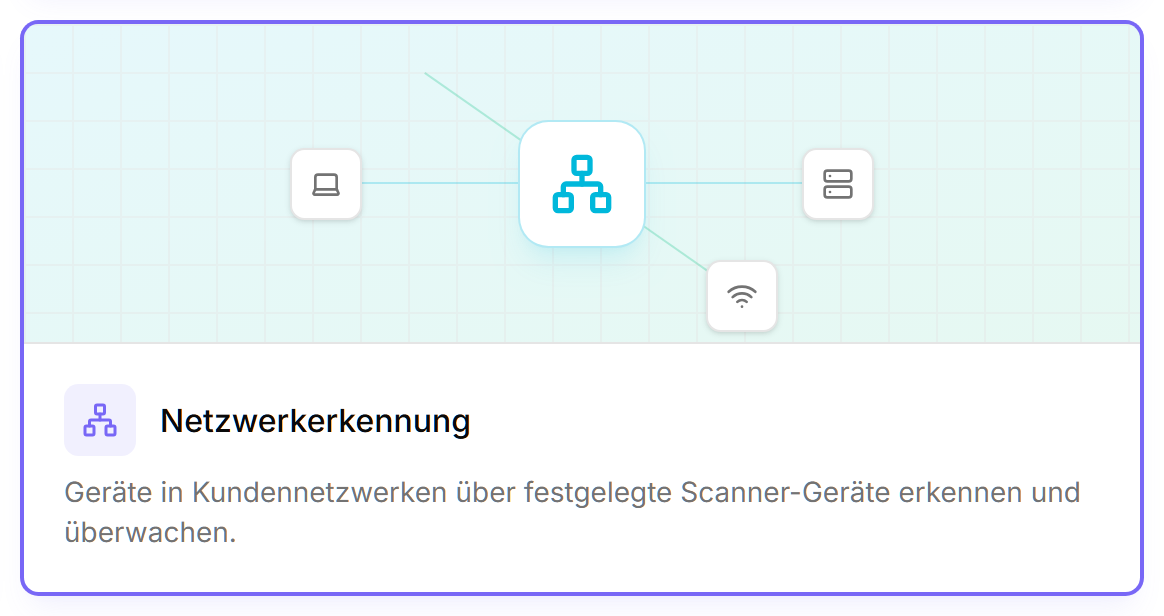
Network scan (Beta) — Discover devices on the network automatically and take them straight under monitoring.
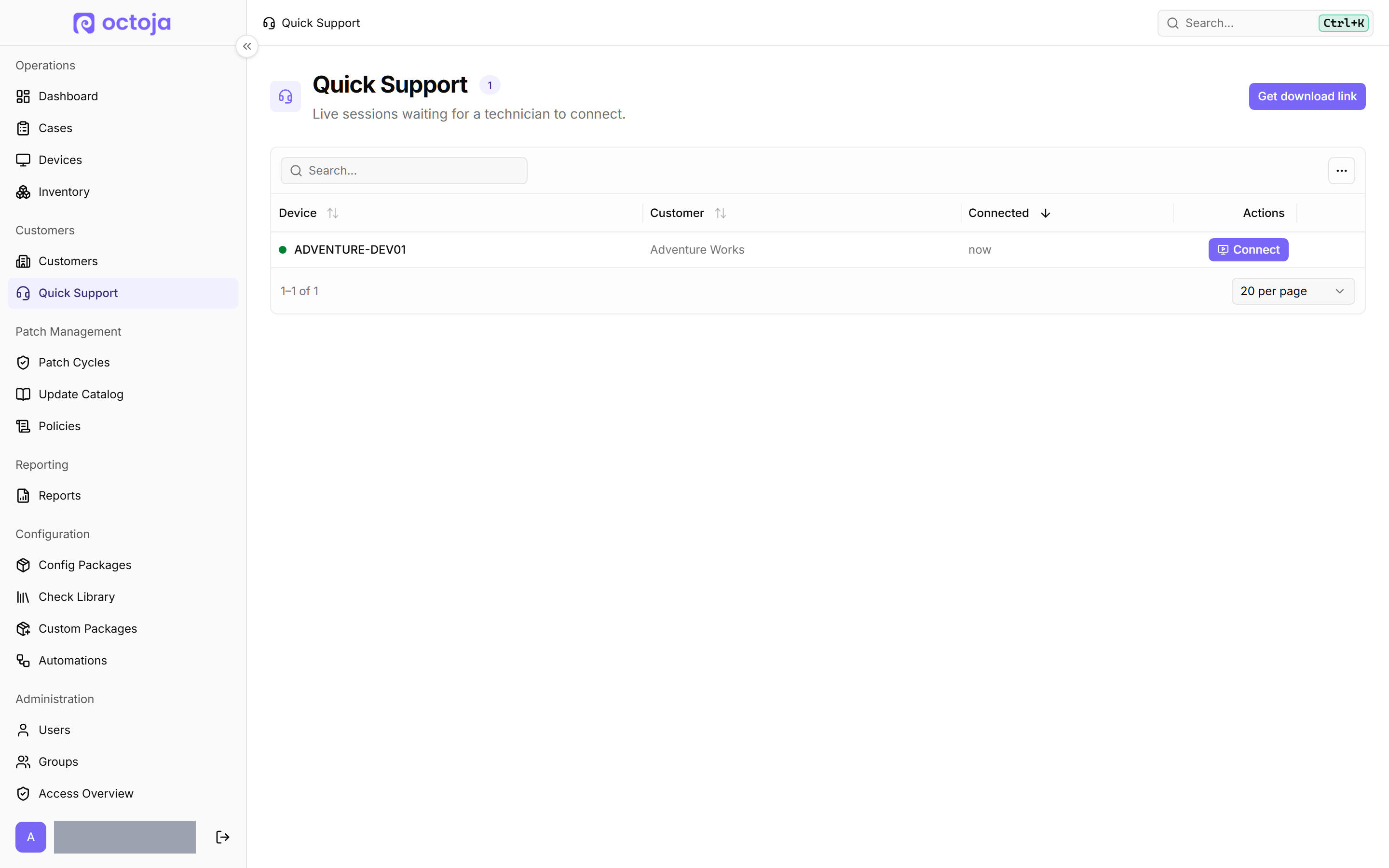
QuickSupport (Beta) — Support customers through a download link – no agent installation, and only after their consent.
AI assistants over MCP — Operate a remote desktop with your consent, edit devices and customers and create custom SNMP checks – within your permissions.
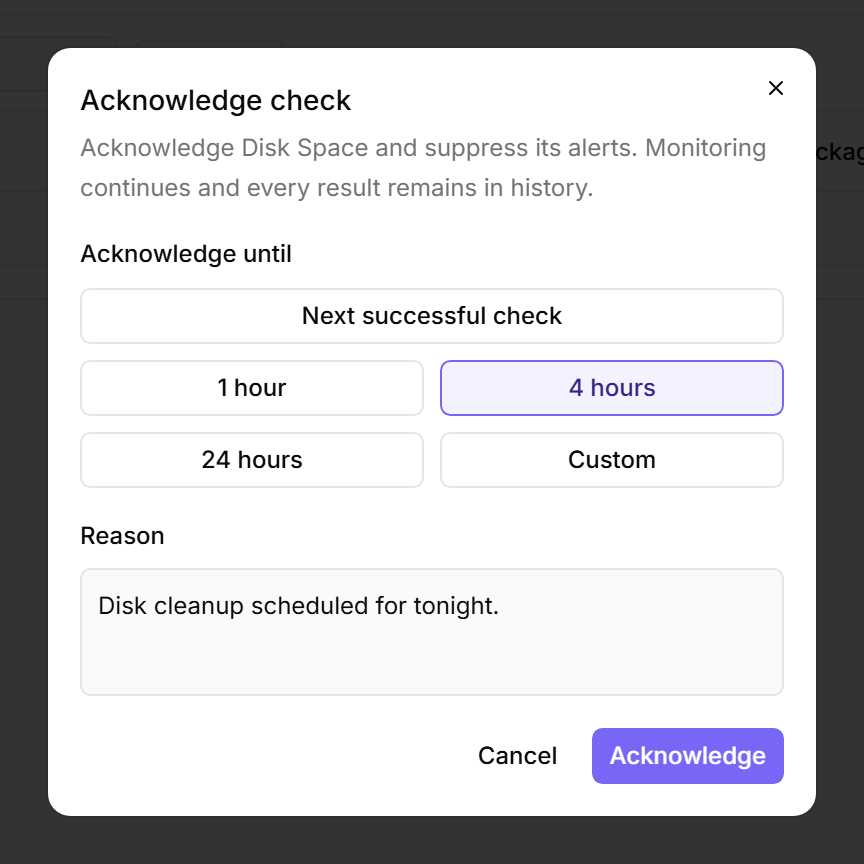
Acknowledgeable checks — Temporarily silence known warnings and critical states with a reason while monitoring keeps running.
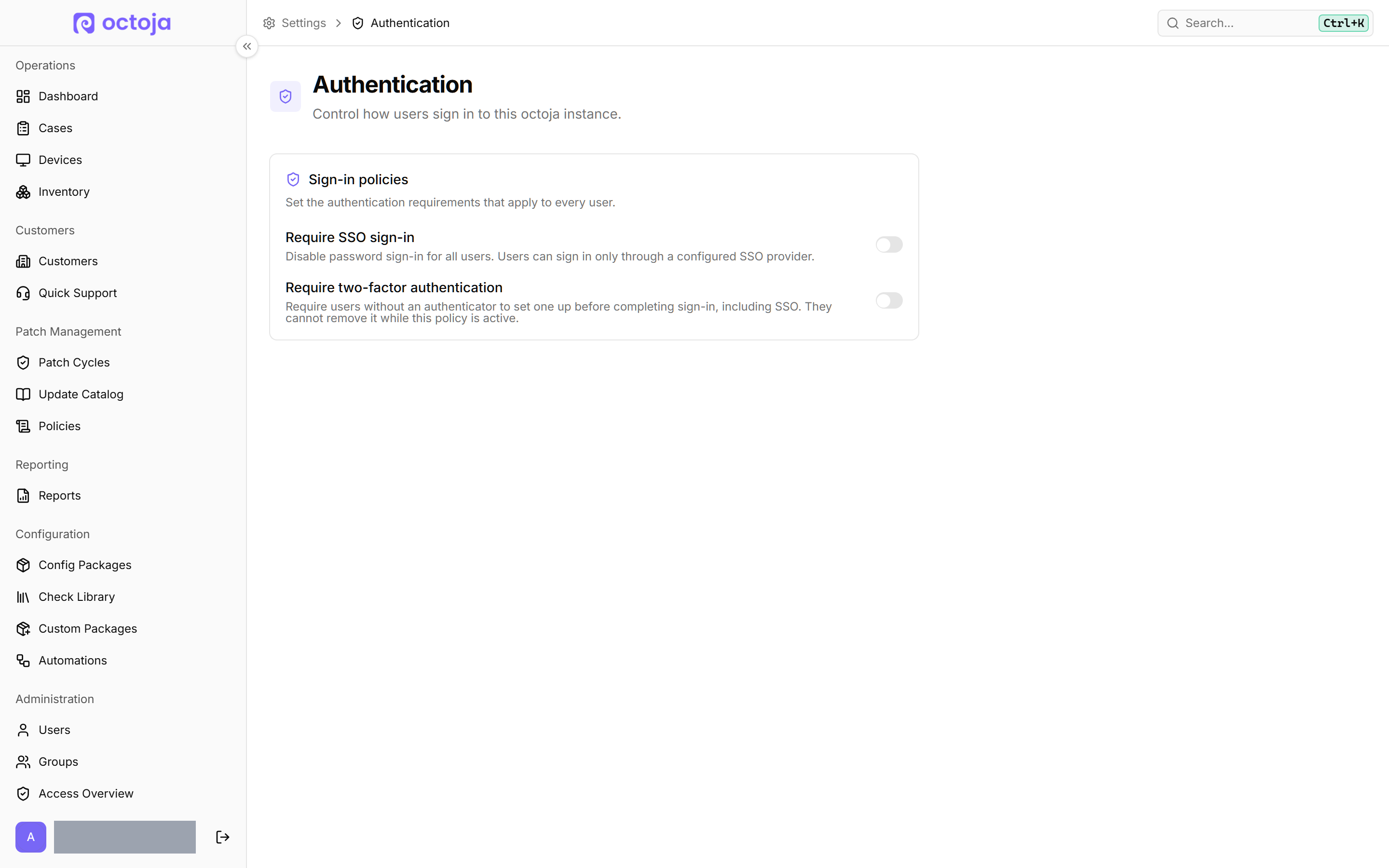
Enforce SSO & two-factor authentication — Require SSO sign-in or an authenticator for every user, plus Italian and Spanish for the web interface, agent and e-mails.
Better reports & testable automations — New patch status and software change reports, flexible recipients, and automations you duplicate and test step by step.
New
Settings & access
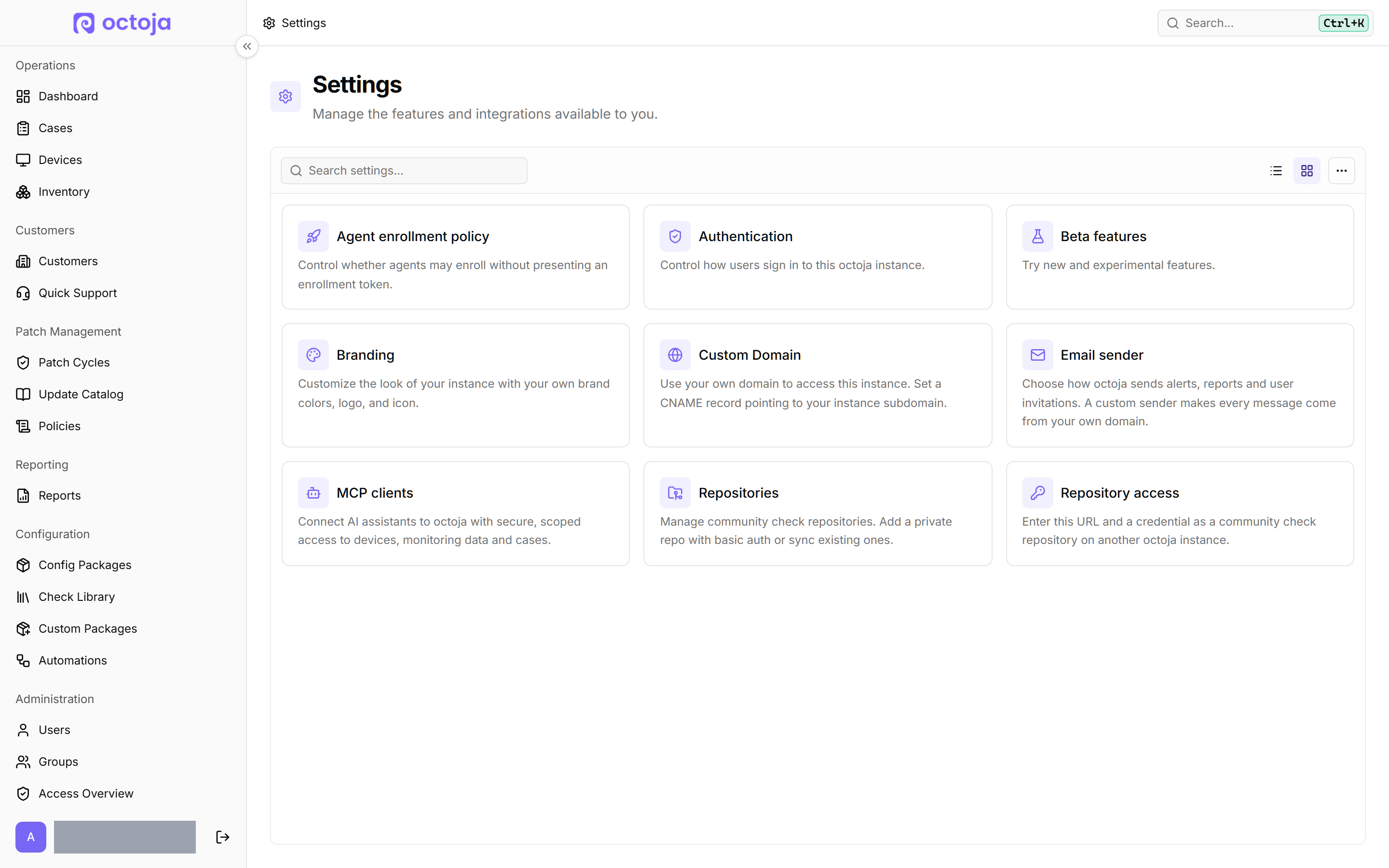
Central settings — Administration → Settings now also holds custom domain, email sender, agent enrollment and branding next to authentication, beta features, MCP clients and repositories – one searchable area.
SSO & two-factor authentication — SSO sign-in or setting up an authenticator can be required for every user – SSO users included.
Support platform access — The Support platform switch is also offered in the invite dialog and is enforced server-side.
Italian & Spanish — New languages for the web interface, agent window and e-mails. A language chosen through Ctrl+K is saved to your profile.
AI assistants
Remote desktop over MCP — Assistants can operate screen, mouse and keyboard – after your Control remote computers consent and within your remote desktop permissions.
Configuration & checks — Assistants can edit devices, aliases, customers and custom fields, and create SNMP checks with a live test. Permissions and auditing match the web interface.
Monitoring & rules
Acknowledge checks — Warnings and critical states can be acknowledged via Acknowledge on the device's Checks tab, with a reason, until the next success or for a chosen period. The check keeps running; alerts, cases and dashboard counts are suppressed.
Dashboard check filter — The dashboard can be filtered by Check names.
More rule conditions — One condition holds several values with Add value, and rules can target Server role or feature from your inventory.
Custom fields — Multi-select is its own field type, and custom-field tokens in check inputs appear as linked fields with label and source.
Automation & remote support
Involve the user — The Send notification dialog on a device can request a Yes/No/Cancel answer or a written reply and shows what the user picked; later automation steps branch on that answer.
Easier to build & test — Automations can be duplicated and individual steps tested on a device. New conditions check device tags and chassis type.
Terminal as a user — The Toolbox terminal picker lists Logged-in users next to SYSTEM / root; the shell runs in that user's profile on Windows and macOS.
Remote desktop — Ctrl+Shift+X types the clipboard (also on login and UAC screens), Ctrl+Shift+M switches display, Ctrl+Alt+End sends Ctrl+Alt+Del. Windows supports the native H.264 codec WmfH264 for lower latency.
Beta features
QuickSupport — Customers → Quick Support creates a download link for remote support without installing the agent. After the customer's consent, remote desktop, terminal, registry and event log are available until they close the window.
Network scan — Scanner devices you designate per site discover devices on the customer network; the Network tab on the customer page lists the findings, which you take over in bulk, dismiss or let Auto-add monitor. You switch network discovery on under Settings → Beta features.
Also in beta — Proxmox VE host management and the UniFi Site Manager integration have been available since the previous release; switch them on under Settings → Beta features.
Patches, software & reports
Patch reports — Current Patch and Action Status separates approval from installation; the former detailed report is now Patch Performance Evidence, and definition updates can be condensed or hidden.
Software Change Report — A new built-in report lists software installed, updated or uninstalled in the selected period.
Flexible report recipients — One combined PDF for all customers or separate PDFs for several selected sites.
Integrations & device information
TANSS — Network devices are synced as peripheries with type and firmware instead of as PCs; UniFi identifiers and Securepoint serial numbers are carried over.
c-entron Service-Board — Configurable ticket language, ticket texts without octoja branding and ticket numbers in the delivery log.
macOS Server — New device type for tables, filters, TV View and the macOS templates; Change Device Type now works for Macs, too.
Hardware details — The device page shows battery, power profile and enrollment date.
Improved
Settings & branding
Dedicated settings pages — Custom domain, email sender and the enrollment policy with Allow open deployment each have their own page.
Branding — E-mails use the window title as fallback sender name. Mobile home-screen shortcuts take your icon and title; the octoja copyright line on the login page is gone.
Remote support
Remote desktop & Toolbox — The remote cursor shape is shown, on Windows hosts without a monitor too. Toolbox windows remember their size and position, and the Services view shows the account each Windows service runs under.
File explorer — Archive actions read Compress to ZIP file and Extract all, and long paths stay on one line.
Automation & software
Automation assignments — The device's Automations tab shows each assignment's trigger and hides manual automations.
Software automation — The step is now called Install or update software and restores saved selections when editing; outputs keep up to 64 KB.
Update exclusions on Linux — Never update these packages also applies to APT.
Custom packages — The package wizard shows the maximum upload size up front and rejects oversized installers and companion files before analysis.
Patches & agent updates
Patch execution — Alerts are suppressed while a device runs a patch cycle. Disabling the Windows Update interface now hides all of its notifications, too.
Device log — Completed update-all runs are recorded in the device log.
Agent updates — Smaller downloads through binary deltas. The Windows quick installer points out an installed Visual C++ runtime; the deployment page explains the settings file more clearly.
Maintenance mode — The maintenance banner on the device page lists the reasons for active windows. Patch cycles set maintenance under the patch policy's name and only for the actual window.
Monitoring & reports
Network checks — Agentless devices automatically use their stored address and SNMP or TR-064 connection; separate credentials in the check are gone.
Check configuration — Size thresholds offer a unit selector (KB to TB); custom SNMP probes collect values without thresholds, too; the monitoring device picker suggests the matching customer.
Reports — Check widgets can be filtered by monitoring checks, antivirus coverage by device types. Check details show last user and last seen.
Mappings & Securepoint — Auto-match is available in every site and host mapping dialog. The Securepoint setup hint names portal.securepoint.cloud as the place to create the API key.
MCP tools — Clearer input descriptions and explicit error messages. Tools for custom checks support result text templates.
Usability
Search & pickers — The global search finds devices and customers by custom field values. Enter picks the first filtered result in pickers.
NFR customer — The customer list marks the NFR customer with a badge, and it cannot be deleted.
Fixed
Remote access & agents
Remote desktop — After a logoff on the remote device you land on the session chooser, and the console reopens at the login screen. Italian keyboards type the period correctly, NumLock is restored and numpad keys type the right characters.
Web Console & file explorer — Heavy device pages load completely and sessions work in Safari. Downloads of growing files complete; dropping folders shows a notice instead of creating empty files.
Linux agent — Agents stay online after long uptime, too.
Windows agent — Failed installations are cleaned up properly, and launcher and agent no longer stop each other during recovery. Duplicate tray icons are gone.
AI screen capture — Screenshots for assistants over MCP keep working across Windows sign-in, lock and UAC transitions.
Hardware inventory — RAM slot counts include every memory array, so multi-array systems no longer under-report slots.
Patch & software management
Patch approvals — Manual approvals are never overwritten by a later background refresh.
Patch cycles — Clearer notes on auto-approved and emergency cycles. Deleted policies cancel unstarted cycles; expired maintenance windows are handled correctly.
Patch execution — The same Windows update is never submitted twice in one batch.
Software deployment — WinGet works without the Microsoft Store source and reports failed uninstalls correctly; deployments scheduled for restart are not missed when the agent starts before the network is ready.
Patch policies — A failed policy reconciliation on the agent is retried after about a minute instead of waiting for the next regular interval.
Reports & integrations
Reports — Widgets, previews and PDFs respect user access. Scheduled reports do not run when access is revoked, and patch and antivirus ratios count only agent-capable device types.
Bitdefender, UniFi & Securepoint — Mappings saved during a sync are kept. Bitdefender respects GravityZone rate limits and no longer shows stale endpoint counts after a disconnect.
Acronis — Devices are linked deterministically via the local Acronis agent ID, and domain-joined devices listed with a full DNS name are matched, too.
Service-Board tickets — When a ticket cannot be created because settings are incomplete, the delivery log shows the reason instead of failing silently.
Securepoint — Connected Securepoint devices keep a fresh last-seen timestamp instead of appearing stale.
Monitoring
Availability — Brief outages no longer show as 100 % availability.
Interface & usability
Sign-in & language — Expired sessions return you after signing in. The language choice sticks; translations, date displays and German BitLocker details were corrected.
Sorting & mappings — Devices sort by their displayed alias, and the customer mapping dialog stays fast even with hundreds of customers.
Navigation & layout — Device tabs scroll instead of wrapping, the collapsed sidebar scrolls, the device list uses the same row height as every other table, and expanded vulnerability rows wrap their text.
Custom domain — Rejected changes show a clear error message.
Checks
Check updates are rolled out separately from the octoja release.
New checks
Backup & telephony — Veeam Backup for Microsoft 365 monitors backup and copy jobs across all organizations; STARFACE checks licence, certificate, NTP, call load and SIP reachability.
Antivirus — Acronis Cyber Protect Antivirus and VIPRE Endpoint Security check services, protection state and definitions on Windows.
Location — Earthquake Monitor warns about quakes near the device's location.
Proxmox cluster & services — Proxmox Cluster & Quorum monitors quorum, node membership, Corosync links and pmxcfs. Proxmox Services & HA checks essential Proxmox VE services, cluster HA problems and failed storage replication jobs.
3CX Phone System — Monitors a 3CX V20 PBX through the official Configuration API: licence and TLS certificate expiry, services, firewall, phones, trunk and extension registration, call capacity, backups and automatic updates.
Improvements
ESET Security — Supports macOS from ESET 7 and reliably warns when the firewall or network protection is disabled.
Printer (SNMP) — Brother printers report their ink levels.
Warranty & end of support — HP Warranty reads the warranty locally via HP's Client Management Script Library, so API credentials are only needed for extra serial numbers. Alert timing and severity for HP Warranty, Lenovo Warranty and OS End of Life are configurable.
APC UPS — Configurable temperature thresholds for warnings and critical states.
Veeam Backup & Replication — Agent policies are evaluated per protected computer.
Hyper-V — The VM status check can optionally monitor each VM's CPU usage with warning and critical thresholds.
Fixes
Backup — The Acronis check works on macOS. Synology reports unreadable task lists and counts failures correctly, Comet recognises server-side schedules and MailStore evaluates runs without a profile ID separately.
Security — SentinelOne determines console connectivity from the heartbeat. Antivirus Status handles Defender next to third-party products on Windows Server correctly.
Hardware & network — Unknown Fujitsu subsystems no longer degrade the result, iDRAC wear warnings apply to SSDs only and ZFS capacity bars use the right colours. SMART no longer hangs storage on Windows RAID hosts; SNMP text with trailing control bytes decodes cleanly.
Operating system — Failed logins are detected on Debian 13.
This release is about control and evidence. You decide which updates reach your devices and when — a config package can skip the packages you name and hold back versions younger than a few days — and you can narrow the device list to fleet questions the quick filters cannot express. The audit log now records every sign-in with the IP address behind it, filters by source, severity, user and date, and downloads as a CSV file. Acronis Cyber Protect Cloud joins the integrations and three new checks arrive; the rest is polish and reliability — Windows patch runs finish and count what they did, devices stop dropping offline after an octoja update, and a long tail of remote-session and check fixes lands behind it.
New
Skip packages and hold back new versions — A config package set to Update all can now skip packages listed under Never update these packages and hold back versions younger than the Minimum update age (days). The age gate covers winget and Chocolatey only. Under every other package manager everything updates, and a version octoja cannot date installs anyway. winget dates from when octoja's catalog first saw the version, Chocolatey from the real publish date. Use the manager's ID (Mozilla.Firefox, not Firefox); max 200 per deployment, 0–365 days.
Filter the device list with a rule or a query — The device list gains an Advanced filter, built with the same rule builder as config packages, tag rules and patch policies, or typed as an OQL query, octoja's own filter language. It combines with the quick filters instead of replacing them and travels with saved views and shared links, so a view restores layout and filter together. It can never widen what you are allowed to see. If octoja cannot read a shared or edited filter, it warns you and drops your rule — the list still shows only what your permissions allow.
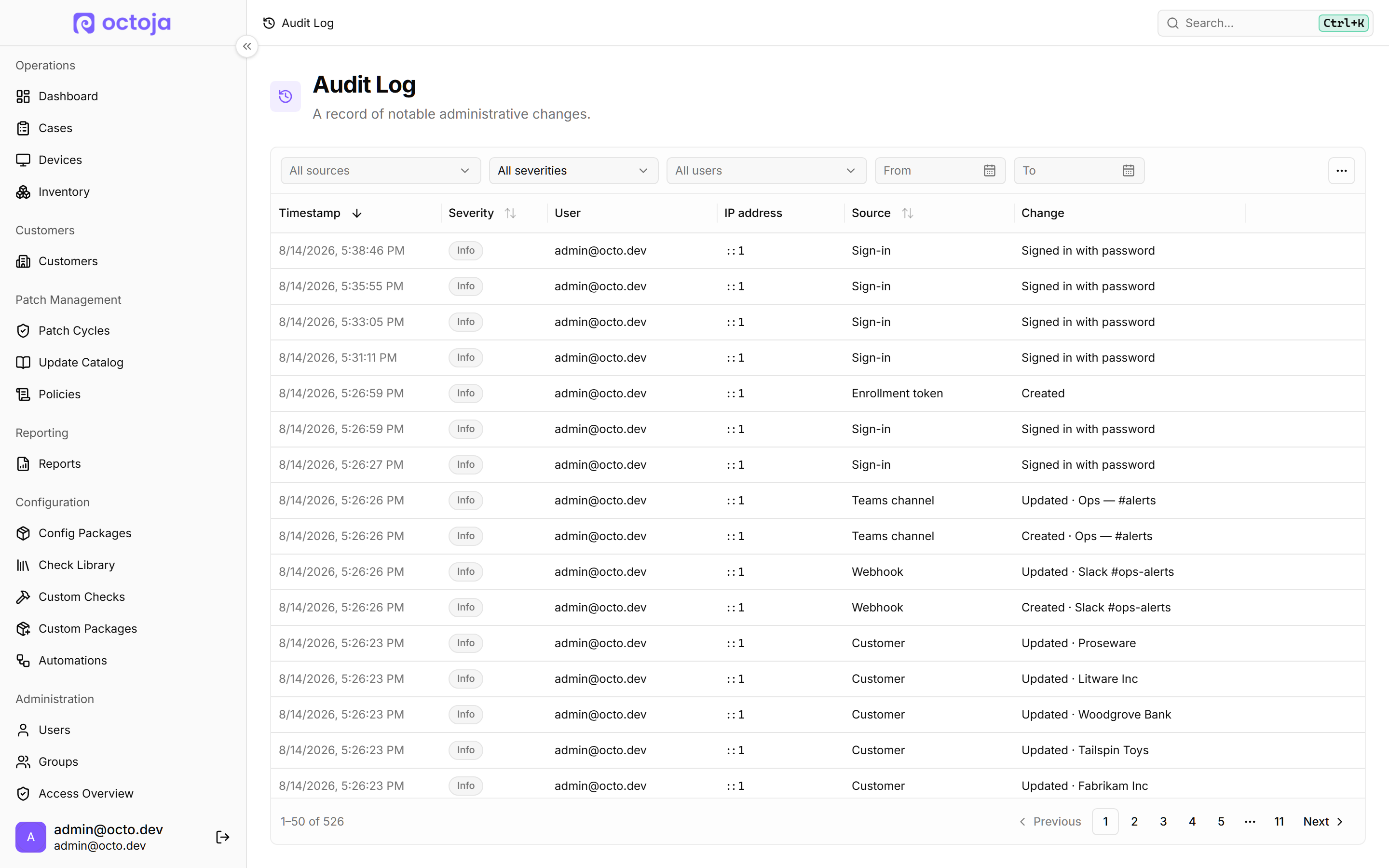
Sign-ins, IP addresses and a CSV export in the audit log — The Audit Log now logs every sign-in, password and SSO separately, with the IP address behind each entry. Narrow by source, severity, user and date with All sources, All severities, All users and From / To, then download that with Export CSV. Every entry kind carries an IP from now on; older ones stay blank in that column. Large exports are capped: octoja tells you how many entries it wrote and asks you to narrow the filter for the rest.
Acronis Cyber Protect Cloud integration — Connect octoja to Acronis Cyber Protect Cloud under Integrations and match each customer to their Acronis tenant with Match customers; backup protection status and Acronis alerts appear on those devices automatically. Setup needs an API client from the Acronis management console: Data center URL, Client ID and Client secret. A companion check reads last-backup age and result and active Acronis alerts from Acronis itself, nothing extra on the device. Assign it yourself, like any other check.
Bulk actions: schedule device actions, close cases at once — Select devices and use Run or schedule action to restart, shut down or run a saved automation, Now or Schedule for later; cancel pending ones before they fire. In Cases, close several at once or add one time entry to all, max 100 cases per bulk request, shown in case history as created manually in bulk. Device-list checkboxes are always visible now, the Multiselect toggle is gone, and every action lands in the device's run history, restarts and shutdowns included.
Share a saved view with your colleagues — Hand a saved device-list or dashboard view to colleagues with Share with other users; they find it under Other shared views in the view menu. It is read-only for them: they can adjust columns, sorting and filters for their own session and take a copy with Duplicate as new view…, but nothing they change reaches yours. Views saved before this update stay private until their author shares them explicitly.
Three additions to automations — Target devices gains an Advanced editor for query-written rules; automations with nested rule groups, uneditable before, now open there. A Roll out Bitdefender agent step installs it where missing: Windows only, needs the Bitdefender integration connected and customer matched, up to 25 minutes. A View Automations permission gives read-only access, running saved automations and run history included, while changes still need Manage Automations, and nobody loses access on upgrade. One side effect: automations now respect customer and device scope, so users limited to certain customers see fewer entries than before.
A TV View board with one card per device — TV View can now show one card per device carrying that device's worst result instead of one row per failing check. Switch with the Checks and Devices buttons in the header; the check board stays the default, and device cards open the device honouring your open-in-new-tab preference. The single criticality dropdown is replaced by three toggles — Critical, Warning and Offline — that combine freely, none selected meaning all, and both boards obey them.
Update FRITZ!OS from octoja — A monitored FRITZ!Box now shows the newest firmware available and whether an update is pending, and Install update starts it after a confirmation — the box restarts and the internet connection drops for several minutes, so it needs the Run Maintenance permission. Two readings were corrected too: Max upstream and Max downstream were a thousand times too low, and the traffic counters are relabelled to show they count only since the current connection was established.
Synology NAS hardware on the device page — The page of a monitored Synology NAS now carries a Hardware card with model, serial number and DSM version, a NAS card with system, power supply and fan status, DSM update status and temperature, and tables of its Drives and Volumes — the page previously showed only CPU, memory and interfaces. It needs SNMP to be reachable and the device typed as a NAS in octoja; models without a temperature sensor show no value rather than a zero.
Odoo 18 and older now connect — octoja now talks to on-premises Odoo 18 and older as well as Odoo 19, works out by itself which one an instance speaks, and asks for the Username (Odoo 18 and older) that the older ones need. A connection can no longer be saved without a successful Test connection, so a wrong key is rejected at setup instead of saving and returning nothing. Existing Odoo 19 connections keep working untouched, with the username left empty.
Send agent logs to octoja support — A device's Agent logs entry, previously Download logs, now opens a dialog first: Send logs to octoja support uploads that agent's logs and returns a reference number for the support chat, while Download now is the old one-click download. Sending shares your name and email, the device name and your Note (optional); the archive is capped at 50 MB and each upload is written to the device's log. It needs the same right that opens a device's files.
Two additions for remote sessions — Under Auto-lock after remote desktop, On Terminal Servers, lock only the console session locks only the console when a session ends. Switch it on yourself — it is off by default and stays greyed out until the parent setting is on. Set it per device or fleet-wide in a config package. After a drag-and-drop upload, Show in Explorer opens the remote Downloads folder with the file selected — Windows only, and only with a new enough agent. Typed keys now reach the remote machine, not octoja's toolbox shortcuts.
An RPM package for Red Hat-family Linux — You can now install the octoja agent on Red Hat-family Linux systems from a published RPM package, alongside the Debian package that was already available. Linux agent packages are also built to run on RHEL 8-era systems and newer, so a later agent update can no longer replace a working RHEL 8 installation with binaries that machine cannot start.
Links in custom fields are clickable — A link kept in a text or multiline custom field is now clickable straight from a device or customer page: Open link opens a single one, and several are offered in a dropdown. Full addresses — including rdp:// and ssh:// — are recognised, as are ones beginning with www, which open over https; duplicates within the same field collapse to one entry.
Improved
The update catalog and patch cycles read straight — Update Catalog entries now show status across All Devices and let you switch between every covering policy. Identifiers read as KB5034123 in patch cycle tables, update details and CSV exports; exclusions match with or without the prefix, and devices with no update yet read Pending, not Scheduled. Open patch cycles refresh at service start, hourly and on Refresh now. Affected-device counts now come from the devices listed, and ownership follows today's policy targeting. Expect both to change on updates you never touched.
Search, filter and export a device's inventory history — You can now search a device's Inventory History, narrow it to one change type — Software, Services, Pending updates, Local users, Network adapters, System information, Hardware or Security — and download the result with Export CSV, which covers every page of the filter, not just the rows on screen. Search also finds coalesced software updates, where an old and a new version share one entry. The time-range picker has moved out of the card header into the new toolbar row.
octoja stays responsive on large fleets — The device list, dashboard, patch-cycle and Update Catalog lists, and a customer's Alarm History (Last 14 Days) load faster; alert evaluation uses far less memory; an octoja restart no longer brings a wall of agent requests. Nothing changes about what they list, which alerts fire or what notifications contain. A check repository change reaches agents served by another instance of the service after up to five minutes; a run you start yourself and server-side evaluation are immediate. A device moved to another customer shows no Lywand Score until the next synchronization re-scores it.
Three improvements where checks are written and configured — Script rules — status reporting, non-zero exit codes, privileges — and the SNMP helper reference now sit beside the editor in Custom Checks and an automation's Run script step, which had none. Custom checks ask only for a Name; octoja derives the identifier, so duplicates are impossible, and repository credentials can generate, show and copy a password. Whole-number settings refuse decimals, and a decimal you saved earlier is rounded on its way to the device — 92.5 arrives as 93 — so review the thresholds you typed with a decimal. Only whole-number custom fields insert as a token.
Agentless SNMP checks take the device's own credentials — A check against a network device now uses that device's own address and stored SNMP settings automatically, so one config package covers devices with different credentials; a live test resolves them the same way. If you typed an SNMP community or version into the package, octoja now ignores it and uses the device's stored settings, so check that those are right on each network device. Devices with different credentials start working, and stale hand-typed values stop being used. Nothing is written back into the package.
The dashboard tree follows your filters — The customer and site tree now lists only customers and sites with devices matching your active filters, and its counts match the device list exactly. The dashboard's default severity filter — critical and warning — applies to the tree too, so on first load customers with no current issues drop out; a saved default view with no severity selected brings the full tree back. Selecting a customer or site in the tree still does not filter the tree itself.
Alert configurations say which field is wrong — When an alert configuration is incomplete, Save stays clickable and the field at fault is ringed in red, instead of a Save button that quietly did nothing with no hint which field was to blame. Thresholds, windows, schedules and names are now checked in the browser, and nothing that used to save stops saving.
woasi tickets arrive readable — Alerts handed to woasi now carry a readable ticket subject and a plain-text problem description — check, device, status, how often it tripped, the check result and a direct link to the device — instead of raw machine data. You choose the language in octoja, not in woasi: the Ticket language field on octoja's woasi integration page sets it for both and defaults to German, so set it explicitly if your technicians work in another. Recovery has its own subject and wording; every other alert receiver keeps the neutral wording.
Prerequisites and permissions for the agent rollout — The one-line agent install now checks the age of the Microsoft Visual C++ Redistributable, not just its presence, and replaces an outdated one before installing the agent. Without administrator rights it stops and tells you to install the newer redistributable first. The Group Policy (GPO) steps under Automatic Rollout now also tell you to give the Domain Computers group read access to the installer share and add it to the policy's security filtering — without them a rollout silently skips machines.
One German word per concept — The German interface now uses one word per concept: Prüfung becomes Check, Fall becomes Meldung, Vorfälle becomes Incidents, Registrierung in the Windows sense becomes Registry, Anmeldedaten becomes Zugangsdaten in most places, and the check library's Datensicherung becomes Backup. Two maintenance-window options on a device now read Checks and Softwareverteilungen. English and the other languages are untouched.
Run or schedule action moved to the Automations tab — On a device's page, running or scheduling an action now sits as a Run or schedule action button on the Automations tab, next to the automations assigned to that device and its Run history, instead of being buried in the three-dot menu at the top. The entry is gone from that menu, so it is worth knowing where it went; who may run what is unchanged.
TV View opens devices in a new tab — Clicking an alarm in TV View now opens the device in a new browser tab if your profile is set that way, and alarm rows are real links, so Ctrl-click and middle-click open a device in a background tab where they previously did nothing of the sort. The device Alias is available as an extra column — off by default, turn it on from the Columns menu above the table.
A dangling plug and cobwebs on idle devices — A device that has not reported in for more than seven days now carries a clearly visible cobweb on its page. The rest is decoration: an offline device's page shows a power plug dangling from its icon, and starting Wake device plays a short octopus animation that plugs it in; the plug drops back if the wake fails or the device has not returned after about 90 seconds. Nothing about how waking a device works changed.
Two-factor entries file under octoja — Setting up two-factor authentication now files the entry in your authenticator app under octoja rather than the company's legal name, on both the admin user page and your own profile. Anyone already enrolled keeps the old entry name and keeps working — the name is fixed at enrolment and plays no part in verifying codes, so it only changes if they set two-factor up again.
Fixed
Windows patch runs finish, and count what they did — A run no longer fails wholesale over one conflicting update, no longer reports success when the scan failed on every source, and counts installs finishing just after the window closes. A device still installing shows Incomplete, not Missed, and Incomplete blocks automatic ring promotion. Patch windows now fire at the scheduled time zone's hour on Windows versions that previously used the device's local time, as last release described. Finished runs name every update, By Update lists approved updates no device reported on, and not-applicable updates sit behind Show not applicable. Plan for two side effects. Any device under a patch policy now keeps Windows Update suppressed continuously, not only during its window, so anything relying on Windows patching itself in between loses that. Pending updates carry their current release date, so some dates shift forward and a few become eligible on a different day.
Devices stop dropping offline after an octoja update — Devices no longer drop offline in waves after an octoja update, and a restart of the service no longer briefly reports healthy devices as offline before their connections have settled. Affected agents recover by themselves — there is nothing to re-enter, reinstall or re-approve. A browser that runs into the sign-in rate limit now says so plainly instead of showing a generic unexpected error.
Five fixes for remote desktop sessions — On a multi-monitor Windows device, the screen you pick now receives the picture, the mouse and any resolution change, and a screen that used to stay black now streams. A held mouse button no longer sticks on the remote machine when the pointer leaves the session area or the browser loses focus; from a Mac, accented and Option-produced characters such as backslash now type into a remote Windows session instead of firing menus and shortcuts. Very large screens no longer trip a broken scaling option that forced a fall back to slower software encoding. Where an administrator has already switched on Allow physical console access without consent on Terminal Servers, connecting to that server's physical console no longer asks you whether to request the user's consent first. RDP sessions on the same server still ask.
Software deployment and the kiosk install what they should — Devices octoja could not set Chocolatey up on now repair themselves at the next deployment attempt. They used to fail every Chocolatey package, not just the setup step, so expect long-stuck deployments to start succeeding on their own. Your own packages published with Show in Software Kiosk now install when a user presses Install instead of failing with a missing-payload error. A kiosk install also follows the package's Install for setting rather than always installing for all users: this corrects last release's note, so Current user only lands in the signed-in user's profile. winget installs work on a freshly signed-in Windows 10 session, and a Windows deployment whose one-off prerequisite download hits a network hiccup is retried, so one doomed by the network takes about half a minute longer to fail.
Two integration fixes: TANSS matching and woasi reassignments — Matching your customers to TANSS companies opens straight away, even on instances with many thousands of companies. Companies read as Name (12345) with their TANSS customer number, so you can search by it; the list is cached for about 15 minutes, so a company created in TANSS moments ago may not appear yet. Devices moved to another customer or site reach woasi again, stop showing up there under their old customer, and no longer deliver inventory twice. Connecting woasi is lighter too: octoja sends only the changes from that point on instead of pushing the whole fleet up front, so reconnecting no longer re-sends everything.
Local user accounts appear on the device page again — Devices that showed no local user accounts now list them again under Local Users — a single unusable value on one account, typically one that has never signed in, used to wipe the whole list. There is nothing to re-enrol; the list fills again at the device's next inventory run. The same fix stops a literal {} appearing as a value in network shares, server features and license key inventory.
Browser translation no longer blanks the interface — The octoja web interface no longer freezes or goes blank when the browser's built-in page translation is switched on. Chromium browsers no longer offer to translate octoja at all, so anyone who was relying on that has to pick their language in octoja's own display-language setting instead, which covers English, German, French and Dutch.
Two fixes for the macOS agent — On macOS the octoja agent no longer restarts in a loop when it cannot rewrite its own file metadata. A Mac that dropped offline this way, shortly after an agent update, comes back on its own once the fixed agent reaches it — nothing to reinstall. On a small Mac screen the Allow remote support window now fits: the instructions scroll while the button that closes it stays reachable, and a permission's Set up button disappears once granted instead of sitting greyed out.
A failing check stops re-running every 30 seconds — A check that is alerting no longer re-runs every 30 seconds; once its failure has been reported it goes back to the interval you configured for it. The short retry is kept only for the window between the first failure and the confirmed one, so the result history of a long-failing check stops filling with an entry every half minute and gets far shorter and easier to read.
Wake-on-LAN works through a Wi-Fi relay — Waking an offline device over the local network now works when the only online device available to pass the signal on is connected over Wi-Fi rather than by cable. Such a site used to report that no eligible device was available, so the wake could not be attempted at all.
Automation conditions and scheduled action details — Automation step conditions on Device class match again, and you pick the device type from a searchable list instead of typing it. Conditions saved with an English value keep matching; ones typed in German — Drucker, USV, Unbekannt — still need re-picking, and switching an existing condition's variable to Device class resets its value to Unknown, so re-pick there. Scheduled and immediate restarts and shutdowns show their proper name in the run title and breadcrumb; cancelling a pending one uses scheduled-action wording.
Ctrl+K search results stop reshuffling — Results in the Ctrl+K search no longer reshuffle as the slower ones arrive, and the entry you highlighted with the arrow keys stays highlighted, so pressing Enter opens what you were actually looking at. Instant matches keep a fixed first tier and everything that has to be fetched appears together beneath them in a stable order.
A Linux-only check is tested the way a Mac runs it — The custom-check editor's Live test against a Mac now runs the script exactly the way the agent will, so a check that only has a Linux script gets the same verdict in the test as it does on the device, instead of failing on a wrapper the fleet never runs there.
Two fixes your users see — Alert phone calls no longer speak the backslashes in a Windows file path: octoja replaces them with a space in the customer, site, check name and error text before placing the call, so C:\Users is spoken as “C: Users”. The restart prompt that appears on a device after updates install no longer overlaps or cuts off its buttons in German and the other languages, and the countdown sits centred above them.
Three pieces of interface polish — Scrolling down a device's page no longer tints the pinned header strip at the top or leaves flickering artefacts behind it; devices actually in maintenance keep their coloured border and hazard stripe. In the Check Library, hovering a check's description no longer shows a help cursor that made the text look clickable, and the check details dialog no longer scrolls sideways on a small window.
Checks
Checks reach your devices separately from this release: a new or changed check arrives once that check itself is published, not with the update below.
Three new checks — HP Warranty, DATEV and WatchGuard EPDR — HP Warranty reads a device's serial number and warns before its HP hardware warranty expires; it needs an API key and secret HP grants per business through your account manager, polls daily, and skips HPE servers, which get their own verdict pointing at HPE's warranty service. DATEV — Windows only, every 10 minutes — checks DATEV services (found automatically), the DATEV SQL instance, program path and that drive's free space, License Manager and license-server reachability; every service set to start automatically must be running, so a broad assignment can turn machines red until you fill Services to ignore, which takes wildcards. WatchGuard EPDR reports installation, running services, active protection and current definitions, including on Windows Server. One fix lands outside the three: the existing Antivirus Status check now recognises EPDR and the older Panda Adaptive Defense name, so servers stuck on a false “no antivirus” result turn green at their next run.
Windows Update Agent Health reports the real install date — Up-to-date devices stop being flagged overdue for patching, and devices whose real last install predates your threshold start warning for the first time; expect movement both ways. The check now fails instead of warning silently when it cannot collect data at all, and stops printing Automatic updates disabled while Alert if automatic updates are disabled is off. The System Updates minimum-update-age filter no longer follows the device's time zone.
Exclude the virtual machines you do not want watched — In Hyper-V VM Status, switch on Monitor all VMs and fill VMs to exclude, which — like VMs to monitor — accepts wildcards. In Microsoft Hyper-V Host you pick the VMs to ignore from the machines the host last reported, and a new Per-VM integration service exceptions list silences one integration service on named machines while the rest stays watched. Both lists default to empty, so existing assignments behave as before; one side effect: a degraded-integration warning now names the service and is raised once per degraded service instead of once per VM.
Three Synology fixes — The Synology NAS check now names why it cannot read a NAS — no response, denied access, failed authentication or an invalid configuration — and flags a wrong community string as a likely cause. Denied access used to return an empty result, so expect some Synology devices to move from silence to a visible failure. Check that device's SNMP community and its access rights on the NAS; the failure was there before, just invisible. Synology Backup finds the Active Backup for Microsoft 365 tasks that really exist and says so when the NAS refuses the list, so devices stuck on a false “no backup task configured” warning turn healthy at their next run, listing jobs under their configured name instead of a numbered placeholder such as Task 1.
Backup checks stop alarming on backups that worked — Comet Backup splits jobs by schedule and grades by log severity, not wording; index rebuilds and manual runs are listed, never graded. Permanently red devices should turn green, Warn on unconfirmed results is gone, next-run dates show per-schedule estimates prefixed ≈, and devices with no scheduled backup runs warn. Flip side: a run that finished with warnings now counts as successful, so a job that only ever warned can look healthy. Veeam Backup & Replication stops calling weekday-only jobs overdue on unscheduled days; Veeam Backup Agent tells failed queries from empty output.
Failed Logins ignores a server's logins to itself — A domain-joined server no longer sits on critical because of its own routine failed logins, and the card states how many events it suppressed. Every event names the Reason it failed and severity follows it — only credential-type failures go critical, so devices red from clock skew, a Windows defect, an unreachable logon server or an unspecified logon error drop back; account, time and workstation restrictions still alarm. Where the regional format is not English the check was discarding every event. Those devices report real results for the first time, so expect new alarms there.
UniFi RAM figures match the device's own dashboard — The UniFi (SNMP) check no longer counts reclaimable cache as used RAM on switches and gateways, so warnings firing on cached memory clear at the next run. Devices that publish no used-memory figure showed 0%; they now report the real value where one exists and nothing where none does, which can cross your RAM thresholds and raise alarms that never fired before. The check also waits longer for a slow reply, so gateways that intermittently reported nothing now answer.
No offline result while octoja is still starting — The hold now covers checks you trigger by hand, and a device with a live connection counts as online even when its last recorded contact looks out of date — closing last release's settling-period gaps, where a manual evaluation could still write a false critical result and fire an alert. Trade-off: right after an octoja restart, device-online results are held back a little longer, so a genuine outage in that window is reported later.
Two disk checks report what they really know — Missing disks stay critical in Disk Presence until you approve them under Approved missing disks, pre-filled with the currently missing disks. An alert that used to clear itself after three days now stands until you act, so expect more standing criticals. SMART Disk Health stops warning about undeterminable health on RAID-controller volumes, which RAID Status owns, so servers amber purely on that turn green. Unreadable health shows a neutral state, not a warning; real faults and temperature breaches report as before.
NSLookup completes a short host name — NSLookup completes a short name such as SRV-DC with the device's own DNS suffix, and the result shows which name was Queried. Checks failing purely on a short name now pass, so expect a batch of criticals to clear once the check updates. Only the device's primary and per-connection suffix are tried, not a pushed search list, so fleets relying on several search suffixes still need the qualified name. Names that already carry a domain, end in a dot, or are reverse lookups of an IP address are sent unchanged.
Two checks name the obstacle instead of showing nothing — On hosts running Docker older than 23.0, the Docker Container check now reports that Docker is too old and must be updated instead of claiming no containers were found, so hosts showing an empty list turn red once the new version lands. When ESET blocks the octoja agent from reading protection status, ESET Security tells you to exclude the complete octoja program folder including all subfolders — the path changes with every agent update — then restore any quarantined octoja files.
The printer share counts as an admin share — With Include admin shares turned off, the Network Shares check now also leaves out the printer share Windows creates by itself, while custom hidden shares such as Data$ keep being monitored, so print servers that were flagged over open permissions on that share go quiet. Where admin shares are included, it is badged as an Admin share instead of looking like a normal one.